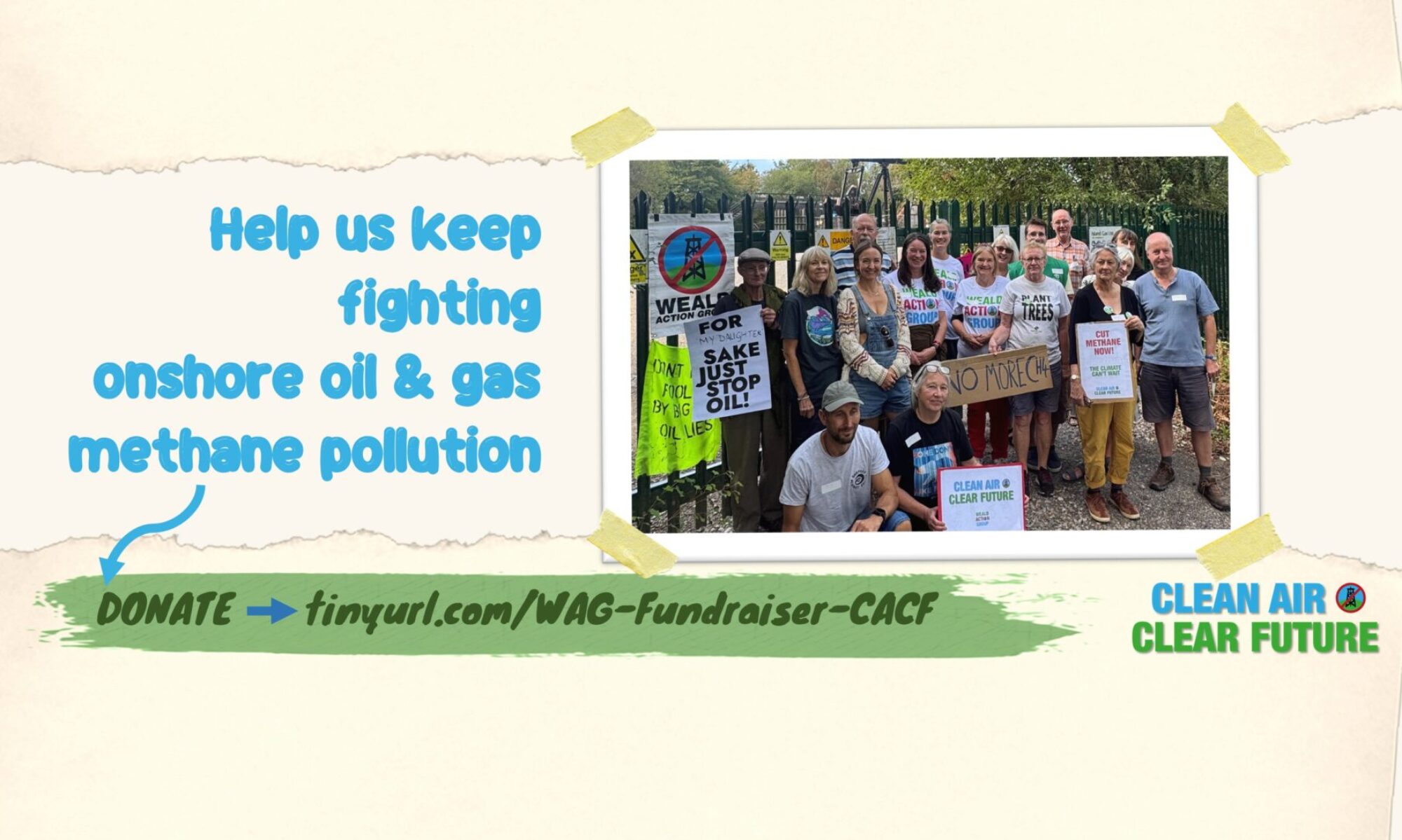
The Weald Action Group has responded to the government’s consultation on proposed changes to planning policy (the National Planning Policy Framework, or NPPF).
Current planning policy allows for – and positively encourages – oil and gas development within licenced areas. The new draft contains some changes – but unfortunate wording and omissions undermine some of the improvements.
Key points we made include:
Remove coal, oil and gas from section 1a of policy S5
The national decision-making policy S5 includes mineral extraction in the list of activities which, “should be approved, unless the benefits of doing so would be substantially outweighed by any adverse effects, when assessed against the national decision-making policies in this Framework”. Yet the NPPF fails to distinguish between the different types of minerals – it’s a broad category that includes construction aggregates, industrial sands and building stone as well as coal, oil and gas. We argue that this policy risks undoing one of the stated aims of the revised NPPF which is to place a “more restrictive approach to the extraction of coal, oil and gas”. It is therefore imperative that this policy is amended to clarify that section 1a of policy S5 does not apply to coal, oil and gas.
Don’t allow new oil and gas sites or extensions within licenced areas
Policy M1 of the revised NPPF removes the requirement to plan “positively” for oil and gas developments. This is a very welcome move.
It clarifies that plans should not identify new sites or extensions to existing onshore oil and gas sites outside of licenced areas. This is also welcome – however we recommend that it should also disallow new oil and gas sites or extensions within licenced areas.
Keep the three phases of fossil fuel development separate
The revised NPPF continues to require plans to separate out the three phases of fossil fuel development – exploration, appraisal and production. We recommend that it should make clear that individual planning applications should not cover more than one phase at a time. Current planning guidance allows this. It is crucial that each phase is accorded the same level of scrutiny. And it should be noted with due seriousness that the 25-year production period for a new oil or gas field now extends beyond the UK’ government’s 2050 deadline for reaching ‘Net Zero’ greenhouse gas emissions.
Assessing the benefits of mineral development
We strongly agree that “great weight”, or “substantial weight” should not be given to the alleged benefits of onshore oil and gas.
This is an important change from the previous NPPF. Developers frequently cite the “great weight” argument in planning statements, putting these developments at a significant advantage – when in reality they contribute very little to the national or local economy.
Financial guarantees are needed to ensure site restoration
We do not agree that bonds or other financial guarantees should only be sought “in exceptional circumstances”, as is proposed. Many of the companies currently exploring for and producing oil and gas in the South of England are limited liability companies that may fail to put aside adequate funds for restoration. Minerals Planning Authorities must be allowed to seek bonds or other financial guarantees from operators to underpin planning conditions and provide sufficient assurance that restoration will be carried out and to a high environmental standard.
Strengthen the presumption against approving new oil and gas projects
Policy M5 states “… onshore oil and gas extraction, should not be approved unless it is necessary: a. To facilitate the exploration, appraisal or production of oil and gas within licenced areas”.
We welcome the presumption against approval of new oil and gas. This is a change in tone and direction compared to previous iterations of the NPPF. However, it is immediately undermined by the words that follow.
This policy essentially allows approval of oil and gas development solely because it is within a licenced area. Although we acknowledge that this is still, unfortunately, government policy, this consultation is an opportunity to require additional rigorous conditions to be met – regarding the climate, the local environment and human health – before approval is considered. It also provides for the opportunity to further restrict approval to conventional oil and gas only. The geologically inaccurate definition of conventional versus unconventional oil and gas in government planning guidance; and the failure of the current moratorium on fracking to prevent the creep of opaque well stimulation practices such as proppant squeeze, matrix acidization and acid fracking, makes the adoption of these conditions even more urgent.
Address methane emissions from onshore oil and gas sites
The current NPPF states that Mineral Planning Authorities should, “encourage the capture and use of methane from coal mines in active and abandoned coalfield areas”. This should also be applied to methane from active and abandoned oil and gas sites too. Methane is a highly potent greenhouse gas and its release from oil and gas sites is often poorly monitored. Methane is emitted when natural gas and associated by-products are released during venting, flaring, dehydration, gas processing, and compression, as well as through leaks from equipment (known as fugitive emissions).
No new coal
We agree with the proposed prohibition on identifying new coal sites, and the removal of coal from the list of minerals of national and local importance. We recommend clarification to remove any ambiguity over the commercial extraction of coal from coal tips.